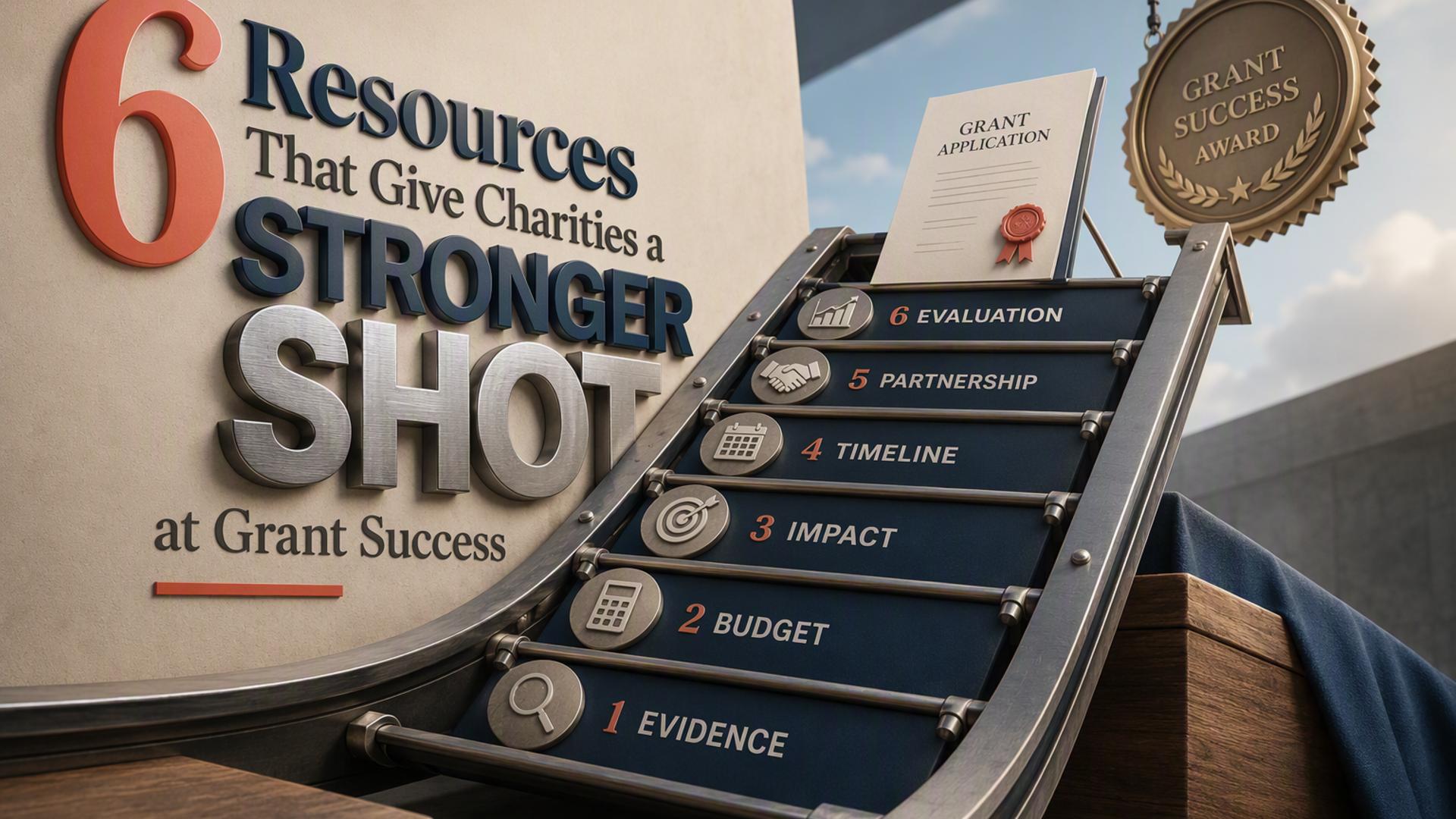
6 Resources That Give Charities a Stronger Shot at Grant Funding
Securing grant funding depends on far more than a well-crafted written submission. Funders are making a broader assessment — evaluating whether the organisation seeking support is credible, financially sound, properly governed, and genuinely equipped to deliver on its promises.
Charities that succeed repeatedly in competitive grant rounds have typically built the underlying infrastructure that makes this credibility apparent. They can generate accurate financial reports quickly, back up their impact claims with data, and present their organisation in a way that builds funder confidence long before any formal meeting. The six tools below directly support those capabilities.
1. Sage Intacct: Financial Management and Fund Accounting
Before awarding funds, grant makers examine carefully how a charity handles the money already entrusted to it. The capacity to produce precise financial reports that break down income and expenditure by fund, show that previous restricted grants have been spent as directed, and present a well-reasoned budget with transparent assumptions is now treated by most serious funders as a minimum standard rather than a point of distinction.
Sage Intacct is designed around the fund accounting principles central to charity finance, making it practical to track expenditure against individual grants, generate the financial reports funders need both at the application stage and during the grant period, and uphold the governance standards that give funders assurance. Charities unable to produce clear fund-level financial information start at a material disadvantage before a single line of their application is read.
Why it matters: Financial credibility is evaluated at every stage of the grant relationship, not only at the point of application. The right financial system keeps that credibility consistently visible.
2. Benevity: Corporate Giving and Fundraising Platform
A number of institutional funders view established corporate partnerships positively — as signals of external validation and as evidence that a charity is not over-reliant on any single income stream. Benevity is a corporate social responsibility and workplace giving platform used by hundreds of major companies to administer their charitable giving programmes, employee volunteering activity, and community investment commitments.
Being listed and active on Benevity opens doors to corporate giving budgets that many charities are not currently accessing, and the corporate relationships that develop through the platform provide tangible evidence of the wider stakeholder support that grant makers find reassuring.
Why it matters: Corporate funding relationships signal external credibility and income diversification — two factors that consistently strengthen a charity's standing in competitive grant rounds.
3. Eventbrite: Community Engagement and Event Management Platform
Grant makers funding community-focused or place-based work in particular want to see that an organisation is genuinely rooted in, and trusted by, the communities it works with. Evidence of this trust through events, public consultations, workshops, and community gatherings is among the strongest forms of proof available — but it must be quantified and documented to carry weight in an application.
Eventbrite offers a straightforward platform for planning and promoting events, and automatically produces attendance records and registration data that can be referenced directly in grant applications and funder reports as concrete evidence of community reach.
Why it matters: Quantified evidence of community participation is growing in importance for funders committed to participatory models. Eventbrite generates that evidence as a natural consequence of events the charity would already be running.
4. Impact Mapper: Impact Measurement and Reporting Platform
The move toward outcomes-based funding has gathered considerable pace. Grant makers are increasingly asking not just whether activities happened, but whether those activities produced measurable change in the lives of the people or communities the charity works with. Organisations that take a systematic, data-driven approach to impact measurement are assessed very differently from those that rely primarily on anecdote and case studies.
Impact Mapper is a purpose-built impact measurement platform that supports charities in designing measurement frameworks, gathering outcome data, and producing the evidenced impact reports that funders now expect at application, at interim review, and at project close.
Why it matters: Demonstrating impact is no longer a differentiator in competitive grant rounds — it is a baseline requirement. A dedicated platform allows charities to meet that requirement in a consistent and structured way.
5. Canva for Nonprofits: Communications and Design Platform
Grant makers draw impressions of an organisation from every piece of communication they encounter, including the presentation standard of application documents, annual reports, and supplementary materials. A charity that communicates through polished, well-structured, consistently designed materials signals that it approaches communication seriously and understands its responsibility to represent its work clearly.
Canva for Nonprofits gives registered charities access to Canva's professional design platform at no charge, making it possible to produce high-quality application documents, impact reports, and funder presentations without a design budget or an in-house designer.
Why it matters: Strong design does not secure grants on its own, but weak presentation can introduce doubts that damage an otherwise compelling application. Canva for Nonprofits removes that risk without adding to costs.
6. Salesforce Nonprofit: CRM and Stakeholder Management
Institutional funders are generally more favourably disposed toward organisations that can show broad stakeholder support rather than dependence on a single funding source. A charity with an expanding individual donor base, active corporate relationships, and clear evidence of community backing presents a more resilient funding model than one built primarily around institutional grants.
Salesforce Nonprofit is a CRM platform developed specifically for the sector, enabling charities to manage relationships with donors, volunteers, corporate supporters, and beneficiaries in a single system. The data it holds on supporter growth, retention, and engagement is directly relevant to grant applications that ask about income diversification and community involvement.
Why it matters: Stakeholder support and income diversification carry increasing weight in competitive grant assessments. A well-maintained CRM makes this evidence straightforward to access and present.
Frequently Asked Questions
How much weight do grant makers give to a charity's filed accounts? A great deal. Most funders review a charity's most recently filed accounts as part of their due diligence process, examining reserves levels, income mix, major areas of expenditure, and whether the accounts carry any audit qualifications or emphasis of matter. Accounts filed late, containing qualifications, or showing financial patterns that prompt concern can significantly reduce the chances of a successful application regardless of how strong the written case is. Filing accurate and timely accounts is a fundamental obligation, not an optional extra.
What level of financial reserves do funders generally look for? Expectations differ between funders, but most want to see that a charity has a documented reserves policy, that trustees have made a deliberate decision about what an appropriate level looks like, and that the current position can be explained clearly. The specific figure matters less than the quality of the governance thinking underpinning it and the confidence with which it can be discussed in a funding conversation.
Can smaller charities compete effectively in grant rounds alongside larger organisations? Yes, particularly where the funder is looking specifically to support smaller or community-led groups. For smaller charities, the priority is ensuring that the quality of their financial management, governance, and impact evidence is proportionate to their scale but demonstrably thorough. A small, well-organised charity with clear fund-level financial records and structured impact data will routinely perform better than a larger organisation with weak governance in rounds designed to match their profile.
How should a charity approach a due diligence visit from a grant maker? A site visit offers the chance to demonstrate in person everything a written application can only describe. Being ready to walk funders through financial management processes, show how outcomes are tracked, and introduce key members of staff — and where possible, beneficiaries — reinforces the written submission. The finance lead should be prepared to demonstrate the systems in place for fund accounting and grant reporting; this is where Sage Intacct's clear fund-level reporting proves particularly valuable.
What is the most frequently cited avoidable reason that strong charities are turned down? Weak financial presentation is the most consistently identified avoidable failure. This includes accounts that do not clearly show how restricted funds have been handled, budgets that lack a logical connection to the charity's financial history, and difficulty in explaining the financial model of a proposed project with precision and assurance. Robust financial management systems that produce accurate, clear, fund-level reporting address this problem directly.